
Project details
- Project period
- 1 Jun 2025 - 31 May 2028
- Total cost
- €6 130 555,00
- Global Health EDCTP3 funding
- €6 130 555,00
- Call identifier
- HORIZON_HORIZON-JU-GH-EDCTP3-2024-01-05-two-stage
- Status
- In progress
- Project type
- Research and Innovation Actions (RIA)
- Disease area
- Emerging or re-emerging infectious diseasesNeglected infectious diseases
- Intervention type
- Surveillance toolsOther prevention toolsDiagnostics
- Overarching topic
- Antimicrobial resistance (AMR) or drug resistanceClimate crisis or climate adaptationHealth securityDigital technologiesEnvironment and biodiversity
Tracking ticks and tick-borne diseases
The ResTick project is creating infrastructure to monitor the distribution of ticks and the diseases they spread, including a key potential pandemic threat.
The challenge
Ticks are found throughout the world, including sub-Saharan Africa, and transmit a range of pathogens, including multiple viral infections. Ticks thrive in woodland areas and infect both humans and animals, including wild animals and livestock. Their ecology is being altered by both climate change and changing land use.
In sub-Saharan Africa, a specific concern is a potentially deadly viral infection, Crimean–Congo haemorrhagic fever (CCHF). Frequently acquired following contact with livestock or wild animals, CCHF has a fatality rate of up to 40%. It is also found in areas outside Africa, including southern Europe and different parts of Asia.
Despite the importance of ticks as disease vectors and the threat of CCHF virus outbreaks, the distribution of ticks and how human activities are altering tick populations in the context of climate change are poorly understood.
The project
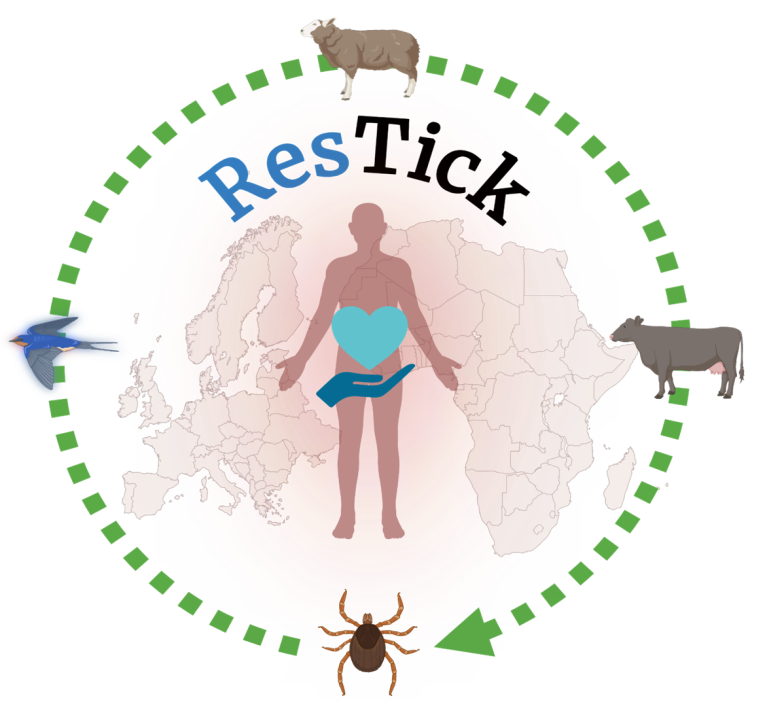
The ResTick project aims to provide a model approach for monitoring ticks and the presence of CCHF virus, to underpin early warning systems and to inform control efforts. It is adopting a multidisciplinary One Health approach, focusing on both domesticated and wild animal reservoirs of the CCHF virus.
The project team aims to characterise around 5,000 ticks a year across multiple sub-Saharan African countries – Benin, Burkina Faso, Côte d’Ivoire, Ethiopia, South Africa, Togo and Uganda – as well as the island of Crete, Greece in Europe. The project’s main focus is on livestock herders, a group at high risk of infection. Animals will be examined for ticks, which will undergo acarological characterisation. Molecular techniques will be used to determine tick species and whether they are carrying CCHF virus.
Molecular methods will also be used to determine whether ticks are carrying acaricide resistance genes. The presence of such genes will be compared across areas with high and low acaricide use to explore how pesticide use affects tick populations. Additionally, the project will test the role of acaricide resistance in exacerbating the disease transmission with a special focus on CCHFV, as well as the socio-economic impact of this phenomenon on livestock producers in sub-Saharan Africa.
The project is also capturing migratory birds that travel between Europe and Africa, to assess whether they might provide a route for the spread of ticks and the pathogens they carry between continents.
To facilitate monitoring activities, the project team is also adapting the ‘Pebble’ diagnostic platform to provide a point-of-care test to detect CCHF viral infections. In addition, a serological survey will be conducted in human and animal populations to assess exposure to the CCHF virus among populations at risk.
Using the information collected, the project team will develop mathematical models of tick and CCHF virus epidemiology to identify high-risk areas for spillover infections and to assess how these might be affected by climate change, environmental disruption, and human population movements.
Impact
The ResTick project will close key knowledge gaps in tick-borne diseases, particularly regarding the Crimean–Congo haemorrhagic fever (CCHF) virus. It will:
- Provide rich information on the abundance and distribution of tick species in multiple African countries.
- Deliver new insights into the prevalence of CCHF virus infections and viral epidemiology.
- Provide new tools for detecting CCHF virus infections, to facilitate disease detection and control, and to track infection rates.
- Decipher the role of acaricide resistance on transmission dynamics of CCHF virus and its impact on livelihoods in sub-Saharan Africa.
- Provide policymakers with tools to identify current and potential future high-risk areas to inform disease control activities.
Collectively, these project activities will generate a clearer view of tick ecology and the potential impacts of climate and environmental shifts, as well as key insights into the zoonotic lifecycle of the CCHF virus, a pathogen with pandemic potential.
Consortium map
Coordinator
IDRYMA TECHNOLOGIAS KAI EREVNAS
- Location
- IRAKLEIO, Greece
- Global Health EDCTP3 funding
- €1 187 500,00
- Total cost
- €1 187 500,00
Scientific project leader
MAKERERE UNIVERSITY
Location: Kampala, Uganda
Beneficiaries
ADDIS ABABA UNIVERSITY
- Location
- Addis Ababa, Ethiopia
- Global Health EDCTP3 funding
- €732 500,00
- Total cost
- €732 500,00
KIARA HEALTH (PTY) LTD
- Location
- RANDJESFONTEIN, South Africa
- Global Health EDCTP3 funding
- €288 430,00
- Total cost
- €288 430,00
UNIVERSITE D'ABOMEY-CALAVI
- Location
- Abomey Calavi, Benin
- Global Health EDCTP3 funding
- €520 000,00
- Total cost
- €520 000,00
BIOPIX DNA TECHNOLOGY ANONYMI ETAIRIA
- Location
- HERAKLION, Greece
- Global Health EDCTP3 funding
- €639 250,00
- Total cost
- €639 250,00
UNIVERSITE DE LOME
- Location
- Lome, Togo
- Global Health EDCTP3 funding
- €450 000,00
- Total cost
- €450 000,00
MAKERERE UNIVERSITY
- Location
- Kampala, Uganda
- Global Health EDCTP3 funding
- €893 625,00
- Total cost
- €893 625,00
INSTITUT NATIONAL DE SANTE PUBLIQUE
- Location
- Ouagadougou, Burkina Faso
- Global Health EDCTP3 funding
- €745 000,00
- Total cost
- €745 000,00
UNIVERSITE ALASSANE OUATTARA
- Location
- BOUAKE, Côte d’Ivoire
- Global Health EDCTP3 funding
- €674 250,00
- Total cost
- €674 250,00
Related projects