
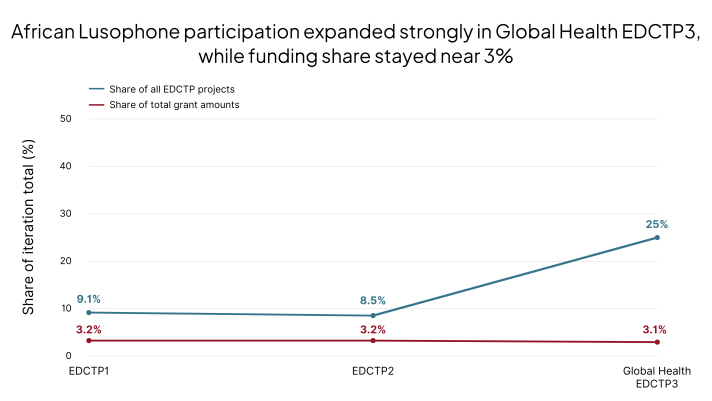
Researchers and institutions from African Lusophone countries are making an increasingly important contribution to Global Health EDCTP3, already taking part in 25% of the project portfolio, a substantial increase compared to previous EDCTP Programme iterations.
Growing participation in Global Health EDCTP3
Currently, five of the six African Lusophone countries participate in Global Health EDCTP3: Angola, Cabo Verde, Guinea-Bissau, Mozambique and São Tomé and Príncipe. Institutions from these countries are involved in 37 ongoing projects, representing around 25% of the current project portfolio.
This marks a significant increase compared with the EDCTP1 and EDCTP2 programmes, under which African Lusophone countries participated in only 9% of funded projects.
At the same time, this growth in participation has not yet translated into a proportional increase in funding: African Lusophone organisations have secured €20.47 million under Global Health EDCTP3, representing 3.1% of the total funding awarded, a share broadly unchanged compared to previous Programme iterations.
The growing participation is also reflected in the diversity of projects in which Lusophone institutions are involved. These range from clinical research and new diagnostics to outbreak preparedness and research capacity strengthening.
Current projects address novel TB diagnostics for children and people living with HIV (STOOL4TB), new methods to test sepsis in newborns (ACROBAT Newborns) - both with scientific leadership from Fundação Manhiça in Mozambique, a project improving access to new antibiotics involving Guinea-Bissau and Portugal (ComBac-Africa), and regional preparedness networks connecting Lusophone institutions with partners across Africa (WANETAM-4).
At the moment, participation remains heavily concentrated in a single country. Mozambique accounts for 98% of the funding awarded to African Lusophone countries, participating in 34 of the 37 projects involving Lusophone Africa. Mozambican organisations also provide scientific leadership in six Global Health EDCTP3 projects.
By comparison, participation from the other African Lusophone countries remains limited. Angola and São Tomé and Príncipe each participate in one project, Cabo Verde in two, and Guinea-Bissau in four. To date, only Mozambique and Guinea-Bissau have received grant funding under Global Health EDCTP3.
Beyond Africa, Portugal has participated in EDCTP-funded projects since 2014 and currently coordinates three projects. Since 2024, Brazil has also joined the Programme, participating in two ongoing Global Health EDCTP3 projects. Overall, seven of the nine countries where Portuguese is an official language are now represented.
Greater collaboration needed
The existing project portfolio demonstrates a strong scientific capacity within the Lusophone research community and provides a solid foundation for further growth. Greater collaboration between institutions, sharing expertise in proposal development and mentoring emerging research teams could help increase the competitiveness of future applications.
'Global Health EDCTP3 builds on more than two decades of partnership between Europe and Africa, bringing together countries with different research capacities, histories and languages. Ensuring that this diversity is reflected in the Programme helps connect expertise, strengthen research capacity and enable institutions across sub-Saharan Africa to contribute to and lead collaborative global health research.'
Michael Makanga, Executive Director of Global Health EDCTP3
This ambition is clearly embedded in Global Health EDCTP3’s Strategic Research and Innovation Agenda and builds on previous efforts.
In 2022, an independent evaluation of the EDCTP2 programme highlighted EDCTP’s role in bridging historical and language barriers, including across Anglophone, Francophone, and Lusophone countries, while strengthening research capacities in countries with historically lower participation, such as Angola and Cabo Verde.
With the third iteration of the Programme, several measures aimed at lowering practical hurdles to participation have been introduced. Since 2024, Portuguese-language Info Days have been organised, making information on funding opportunities more accessible to Lusophone audiences. A networking platform launched in 2025 also helps potential applicants identifying partners and building research consortia.
In parallel, the EDCTP Africa Office offers webinars, practical guidance, and hands-on support across sub-Saharan Africa, including to institutions and researchers in Portuguese-speaking countries.
CT-LUSO: strengthening capacities in Lusophone Africa
Alongside outreach and networking efforts, targeted projects are also helping address some of the structural barriers that can limit Lusophone participation. CT-LUSO project is one such example, strengthening ethical review and regulatory capacity for clinical research across Portuguese-speaking countries in sub-Saharan Africa.
Language barriers can limit access to training and capacity-building resources, creating challenges for researchers and institutions seeking to strengthen clinical research governance. CT-LUSO addresses this gap by supporting the development of legislation and training resources for clinical research governance in Angola, Cabo Verde, Guinea-Bissau, Mozambique and São Tomé and Príncipe.
The project is also conducting a landscape analysis of national regulatory agencies, assessing their alignment with best practices and examining how effectively they operate. By strengthening regulatory systems and promoting knowledge sharing across Lusophone countries, CT-LUSO contributes to creating a more enabling environment for high-quality clinical research.
CT-LUSO itself illustrates Lusophone collaboration: it is coordinated by an organisation in Portugal, with scientific leadership from the Ministry of Health of Mozambique.
EDCTP Association membership
Full participation in the EDCTP Association is an important pathway for African Lusophone countries to engage more consistently in the Programme and a necessary condition to receive funding from Global Health EDCTP3. Non-member countries may participate as non-funded partners but can only receive funding under specific exceptional conditions.
Currently, only three Lusophone countries are full members of the EDCTP Association: Portugal and Mozambique, which joined in 2014, and Guinea-Bissau, which became a member in 2023. Angola has been an aspirant member since 2017, while Cabo Verde, São Tomé and Príncipe and Equatorial Guinea are currently not members.
Expanding EDCTP Association membership, increasing the number of Lusophone institutions taking on scientific roles in projects and strengthening collaboration across countries can help ensure that the scientific expertise and regional knowledge of the Lusophone research community are fully reflected in future global health research initiatives.
Everyone has a role to play
Global Health EDCTP3 and the EDCTP Association stand ready to continue facilitating and supporting this objective through targeted outreach, Portuguese-language communication, networking, support to applicants and investment in enabling research environments.
National governments and research authorities also have an important role to play in strengthening engagement with EDCTP and supporting their institutions, while established research institutions and experienced partners can help emerging teams through mentoring, joint proposal development and stronger collaborations.
Together, these efforts can turn today’s broader Lusophone participation into deeper funding, stronger institutional engagement and greater scientific leadership.
- Publication date
- 29 July 2026
- Author
- Global Health EDCTP3 Joint Undertaking