

Summary
Four fast-track projects funded by Global Health EDCTP3 are testing post-exposure treatment, rapid diagnostics, coordinated surveillance and frontline tools against the Bundibugyo Ebola outbreak. Co-investment from Wellcome and the Gates Foundation has raised the budget from €4 million to €15.8 million.
Global Health EDCTP3 has selected four fast-track projects under its emergency funding mechanism to respond to the Bundibugyo Ebola outbreak in the Democratic Republic of the Congo (DRC), Uganda and Kenya. Additional funding from Wellcome and the Gates Foundation has raised the budget from the initially announced €4 million to €15.8 million.
What the new projects will do
The four actions target Bundibugyo virus (BDBV) and cover coordination, detection, prevention and frontline support. Each builds on existing Global Health EDCTP3-funded projects that were originally focused on other species of Ebola viruses. Their established networks, protocols, clinical trial sites and laboratory capacity enabled a rapid pivot to BDBV within weeks. Some of the activities began on 1 August.
‘Global Health EDCTP3 activated its emergency funding mechanism at the speed an outbreak demands: within weeks, an initial €4 million response became a coordinated package of actions already under way on the ground. This is the value of the African-European research partnership: because the networks, platforms and trial capacity were already in place, they could be rapidly redirected to the Bundibugyo Ebola outbreak. With co-investment from Wellcome and the Gates Foundation raising the total to €15.8 million, it also shows how EU action can catalyse a much broader research response, bringing partners together quickly around shared priorities in surveillance, diagnostics and therapeutics.’
María Pilar Aguar Fernández, Chairperson of the Global Health EDCTP3 Governing Board.
Preventing disease after exposure to Bundibugyo virus
EBO-PEP 2026 is testing whether treatments given after exposure to BDBV can prevent children and adults from developing the disease. The trial is currently evaluating obeldesivir in a randomised controlled trial. Obeldesivir is an experimental antiviral medicine related to remdesivir that has shown promising results in laboratory studies. Unlike remdesivir, which is given intravenously, obeldesivir is taken orally, making it easier to administer during an outbreak.
‘This trial will tell us whether obeldesivir works specifically for BDBV contacts. If the answer is yes, health authorities gain an intervention they can deploy without waiting years for new evidence or regulatory approval. And because the trial is embedded in the national response, the DRC’s Ministry of Health will already be familiar with the results and how to act on them before the paper is even published.’
Placide Mbala, MD, PhD, Head of Epidemiology and Global Health, INRB; Professor, Medical School, University of Kinshasa, DRC; Director of Research, Clinical Trials and Innovation at Africa CDC
If proven effective, obeldesivir could be made available quickly to people exposed to BDBV, helping prevent them from developing the disease. EBO-PEP is a clinical trial jointly promoted by the National Institute for Biomedical Research (INRB) of the DRC and the ANRS Emerging infectious diseases (ANRS MIE / Inserm) of France and coordinated by Inserm.
‘This is now the second-largest Ebola outbreak on record, and it continues to spread. Effective treatments are urgently needed to protect those most at risk. Collaborative partnerships like EBO-PEP, that bring together government and philanthropic research funders with industry, are vital to supporting research to test what works. As trials get underway, it will also be vital to ensure timely, equitable and affordable access to any effective treatments identified.’
Professor Charlotte Watts, Executive Director, Solutions, Wellcome
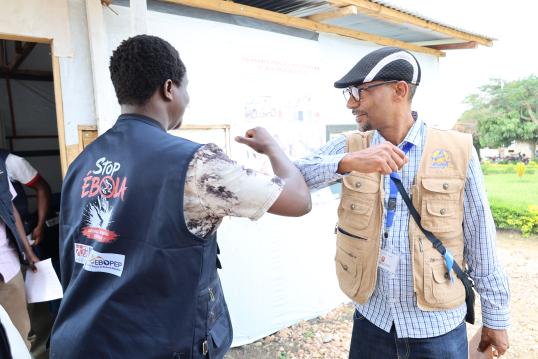
‘Protecting people during an Ebola outbreak means acting quickly while also building the evidence needed to understand what works. Strong research networks and partnerships are now enabling researchers across the region to evaluate new treatments that, if effective, could help prevent disease among people exposed to the virus. By supporting this work, we hope to help researchers determine which approaches could protect more people and ultimately save lives.’
Paulin Basinga, Africa Director at the Gates Foundation.
Global Health EDCTP3 funding: €12.8 million, including €7.4 million from Wellcome and €4.3 million from the Gates Foundation.
EBO-PEP 2026 builds on the Global Health EDCTP3-funded EBO-PEP project that was awarded €3.4 million in 2024.
Read more
Connecting the research response across Africa
EBONET links five Global Health EDCTP3-funded research networks, covering 23 countries and around 100 institutions, to coordinate the research response to BDBV and strengthen surveillance. With no validated test that could be used where patients receive care and no locally available PCR kits, decision-makers often work with an out-of-date picture of the outbreak.
The project maps surveillance gaps, trains staff on BDBV detection and builds a platform to share information, working closely with the Africa Centres for Disease Control and Prevention (Africa CDC).
‘One hundred research institutions across 23 countries already have relevant expertise, existing relationships with communities, and in some cases active studies in the affected region. EBONET's job is to make sure that asset is used as a single coordinated force rather than a collection of parallel efforts.’
Bernard Kikaire, Senior Researcher, Uganda National Health Research Organisation
Global Health EDCTP3 funding: €1 million
EBONET builds on the Global Health EDCTP3-funded SINCEP-Africa, PRESERVE, EACCR4, ACT-PREP and WANETAM-4 projects, co-funded by the Coalition for Epidemic Preparedness Innovations (CEPI) and the UK Department of Health and Social Care (DHSC), through the National Institute for Health and Care Research (NIHR).
Read more
Detecting infections faster in the field
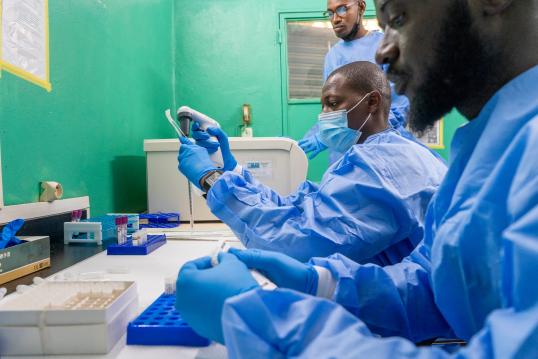
EPoCA-BVD is developing a point-of-care test for Bundibugyo virus. Today, a suspected case can wait days for laboratory confirmation, increasing the risk of further transmission if they are infected, or being isolated unnecessarily. The graphene-based device is being made rugged for field triage sites and aims to give an initial diagnosis within 90 minutes, with laboratory confirmation still required. Results are shared with health authorities as they are produced. It will be evaluated on around 200 to 400 potential cases within a year.
‘We're aiming for a result within 90 minutes, at the point of care, not after a sample has been couriered to a distant lab. That's the difference between isolating someone the same day and losing several days of transmission control. Because the device is internet-enabled, the moment we get a result in the field, health authorities have it too. That kind of real-time picture is what lets an outbreak response stay ahead of the virus instead of chasing it.’
Antonio Jara, Executive Board Member, Libelium
Global Health EDCTP3 funding: €1 million
EPoCA-BVD builds on the Global Health EDCTP3-funded EPoCA project.
Read more
A practical toolbox for those responding on the ground
Ebola-Prep TBOX Plus is developing practical aids for responders working in a remote, insecure area with limited health infrastructure. It covers community engagement with local-language materials, diagnostics (including a remote molecular assay for border posts and district facilities), AI-enabled surveillance with an app for community health workers, and an antibody-based therapeutic against BDBV.
‘Most outbreak responses are forced to improvise diagnostics, communications materials, and surveillance systems under pressure. We're trying to change that. A remote molecular assay that works at a border post, a multilingual AI system that aggregates case reports, and community materials developed with the people who actually need to use them.’
Peter Kremsner, Professor of Tropical Medicine, University of Tübingen
Global Health EDCTP3 funding: €1 million
Ebola-Prep TBOX Plus builds on the Global Health EDCTP3-funded Ebola PREP-TBOX project.
Read more
One million becomes €15.8 million
The response now stands at €15.8 million, up from €1 million. That was the budget Global Health EDCTP3 reserved in 2026 to support research in the event of a public health emergency. Soon after the outbreak began, the European Commission added €3 million, bringing the total to €4 million on 1 July, when it launched the emergency funding mechanism. Wellcome and the Gates Foundation committed the remaining €11.8 million over the following weeks, after the proposals had been submitted. This brought philanthropic foundations' contribution to approximately 75% of the total funding for the emergency call.
This once again demonstrates EDCTP’s ability to bring partners and member countries together around shared research priorities and to act quickly to mobilise substantial additional funds during public health emergencies. The 2024 mpox response followed a similar pattern, this time leveraging substantial member countries' funding. A €1 million budget grew to €12.1 million with co-funding from ANRS Maladies infectieuses émergentes (MIE) in France and the UK Department of Health and Social Care, with 57% of the total emergency call funding having been leveraged from EDCTP Association member countries. Previously, in 2020, EDCTP Association member countries contributed 83% of the €13.11 million COVID-19 emergency call funding.
Part of the continental response
This work is being carried out in partnership with the World Health Organisation (WHO), the Africa CDC, and consortia of national and international partners.
The WHO and Africa CDC Continental preparedness and response plan, published on 5 June 2026 under the ‘One response’ framework, names Global Health EDCTP3 as a key support partner under Pillar 7 on research, knowledge management and access to treatments, vaccines and other medical tools. The new projects address the gaps it identifies, using existing research capacity, surveillance networks, diagnostic platforms and trial protocols redirected to BDBV.
‘Africa must invest in the science needed to confront outbreaks before they strike. The Bundibugyo Ebola outbreak demands urgent action, African-led research and faster access to lifesaving innovations. I welcome Global Health EDCTP3’s investment in these four projects, which will strengthen our capacity to detect infections, advance treatments and support frontline responders. Our ambition is clear: African scientists leading research, African institutions driving solutions, and every breakthrough reaching the communities that need it most.’
H.E. Dr Jean Kaseya, Director General, Africa CDC
From activation to start of operations in 31 days
The emergency funding mechanism is designed to move at the speed of an outbreak. In this outbreak, the first activities began 31 days after activation.
| Date | Step |
|---|---|
| 5 June 2026 | WHO and Africa CDC publish the Continental preparedness and response plan |
| 1 July 2026 | Global Health EDCTP3 activates the emergency funding mechanism and invites participants in eight ongoing projects to apply |
| 7 July 2026 | Deadline for proposals |
| 1 August 2026 | EBO-PEP 2026 official activities begin, building on the consortium's previous actions. |
| 1 September 2026 | EBONET activities begin |
| 1 October 2026 | Ebola-Prep TBOX Plus and EPoCA-BVD’s activities begin |
The actions build on consortia that were already funded, assembled and working in the affected regions. This is why Global Health EDCTP3 focuses on keeping clinical research networks active, connected and ready to respond when an outbreak occurs.
The outbreak today
Six months after it was declared, more than 11,700 cases and over 5,700 confirmed deaths have been recorded in the DRC, with cases confirmed in eight provinces. Uganda, which recorded 20 confirmed cases and 2 deaths, declared its outbreak over on 28 July 2026. Imported cases have since been confirmed in Kenya (9 cases, 2 deaths), Nigeria (1 case) and France (1 case).
The outbreak is caused by the Bundibugyo virus, one of the viruses that causes Ebola disease, for which no licensed vaccine or specific treatment exists. That makes the surveillance, diagnostic and therapeutic work funded here time-critical.
More than a decade of Ebola readiness
Since the 2014-2016 West African Ebola outbreak, the EDCTP programmes have invested around €28.7 million in 15 Ebola-focused projects, or around €124.9 million across 31 projects when broader epidemic preparedness is included. What began as emergency support has matured into sustainable research networks, a tested rapid-response mechanism and regional capacity that can be mobilised as soon as a new outbreak emerges.
About Wellcome
Wellcome is a global philanthropy working to build a healthier future for everyone. We are committed to investing £16 billion in our mission between 2022 and 2032.
We support discovery research and are taking on three worldwide health challenges: mental health, infectious disease, and climate and health.
Our independence and long-term resources allow us to think in decades, take risks and support ambitious ideas. We work with decision makers to enable evidence-informed choices that support science and health. We connect science with people’s lives through public debate, stories and cultural experiences – including Wellcome Collection: our free museum and library exploring the past, present and future of health.
About Gates Foundation
The Gates Foundation is a philanthropic organisation that works to dramatically reduce disease and poverty and build a more equal world.
We invest our expertise and resources in organisations, research institutions, and global alliances that are fueling progress toward a future that is free of infectious diseases, provides economic opportunity for all, and ensures the health of mothers and babies.
Our charitable support, which in 2025 totalled more than US$8.4 billion, focuses on innovative products, ideas, and approaches that have the potential to save and improve the greatest number of lives. Our efforts span more than four dozen program areas and engage thousands of partners that are leading the work on the ground—including nonprofit organisations, government agencies, private enterprises, scientists, community groups, and policy researchers.
Related
- Fresh funding to strengthen Ebola surveillance, diagnostics and therapeutics, 1 July 2026
- Global Health EDCTP3 funds additional research projects to combat mpox - Global Health EDCTP3
- Publication date
- 26 November 2026
- Author
- Global Health EDCTP3 Joint Undertaking