
Ghana has become the first country in the world to approve the fixed-dose combination of ivermectin and albendazole, a new medicine designed to tackle soil-transmitted helminths, a common parasitic infection affecting millions of people in endemic regions of Africa. The Ghana Food and Drugs Authority granted regulatory approval in late December 2025, allowing the medicine to move beyond experimental studies and into clinical and public health use.
This authorisation marks a major milestone for the Global Health EDCTP3-funded STOP2030 project, leading the research on this medicine, and underscores a year of significant achievements. In January 2025, the European Medicines Agency issued a positive scientific opinion on the coformulation, following the successful ALIVE phase II/III clinical trial funded by the second EDCTP programme (EDCTP2). The study demonstrated that the combination has a similar safety profile to single-dose albendazole, the standard drug in mass deworming campaigns, while showing superior efficacy against whipworms (Trichuris trichiura), a species often resistant to single-drug treatment.
'This approval changes the status of this medicine. It is no longer a drug in development or a promise for the future, but a tool that countries can start planning with for their control programmes'
Dr Alejandro Krolewiecki, Principal Investigator of the STOP2030 consortium and Director of Innovation at Mundo Sano
A new tool in the fight against soil-transmitted helminths
Albendazole and ivermectin have been used in public health programmes for decades, but this new treatment introduces several innovations designed for real-world campaigns. The medicine is a mango-flavoured, fast-dissolving tablet, reducing the risk of choking and making administration easier for children. It also incorporates a novel age-based dosing strategy for ivermectin, eliminating the need to measure weight or height for each individual and making the process faster.
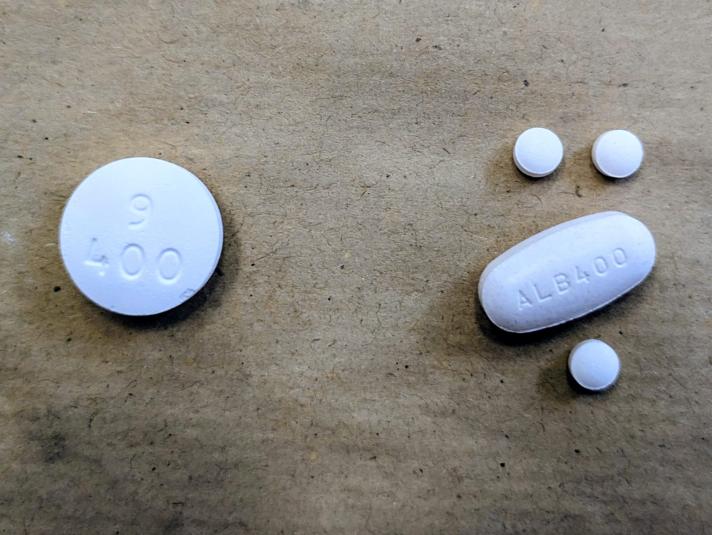
Previously, administering albendazole and ivermectin separately could require between two and six tablets per person, with added logistical complexity and higher risk of underdosing. The fixed-dose combination allows for a single-pill-per-person strategy, simplifying mass drug administration campaigns and improving dosing accuracy. By combining both drugs, it also helps reduce the risk of resistance, a growing concern when relying on a single medicine.
The coformulation is effective against all major soil-transmitted helminth species targeted by the World Health Organization (WHO): hookworms (Ancylostoma duodenale, Necator americanus), roundworms (Ascaris lumbricoides), whipworms (Trichuris trichiura) and a roundworm called Strongyloides stercoralis. It also responds to WHO’s call to ‘develop more effective medicines and drug combinations’ for soil-transmitted helminths found in the 2021-2030 Roadmap for Neglected Tropical Diseases.
'This approval in Ghana is a testament to what sustained investment in research and collaboration can achieve, providing countries with well-evaluated medical countermeasures to tackle neglected tropical diseases and improve the health of communities across Africa. Global Health EDCTP3 is very committed to end-to-end product development that ensures the evaluated tools reach the people that need them most.'
Dr Michael Makanga, Executive Director of Global Health EDCTP3
Next steps: real-world testing and wider access
Approval in Ghana was the first step. The STOP2030 project is now conducting the REALISE trial, which is assessing the safety of the coformulation in real-life mass drug administration programmes. The study involves approximately 20,000 school-aged children between 5 and 17 years old in Ghana and Kenya, comparing the fixed-dose combination to single-dose albendazole. Parallel studies are evaluating acceptability, feasibility, cost-effectiveness, and strategies for equitable access and stewardship, ensuring the medicine is deployed responsibly in endemic countries.
Reaching regulatory approval in Ghana marks the culmination of more than 15 years of research, development and clinical evaluation of the fixed-dose combination. This achievement reflects close collaboration among nearly 20 scientific and public health institutions across Latin America, Europe, Africa and the United States, including Liconsa (Insud Pharma), the producer of the pill.
'The fixed-dose coformulation of ivermectin and albendazole has been in the works since 2010. We are proud of these latest milestones, but also of the journey. It is an example of what successful public-private partnerships can achieve when they share risk, talent and a common goal. We are grateful to Global Health EDCTP3 and all the partners involved in this shared effort'
Dr Silvia Gold, president of Mundo Sano and co-founder of Insud Pharma
With this approval, the STOP2030 consortium aims to provide endemic countries with a practical, effective tool to strengthen deworming campaigns, reduce disease burden, and move closer to the WHO 2030 elimination targets for neglected tropical diseases.
- Publication date
- 18 February 2026
- Author
- Global Health EDCTP3 Joint Undertaking