

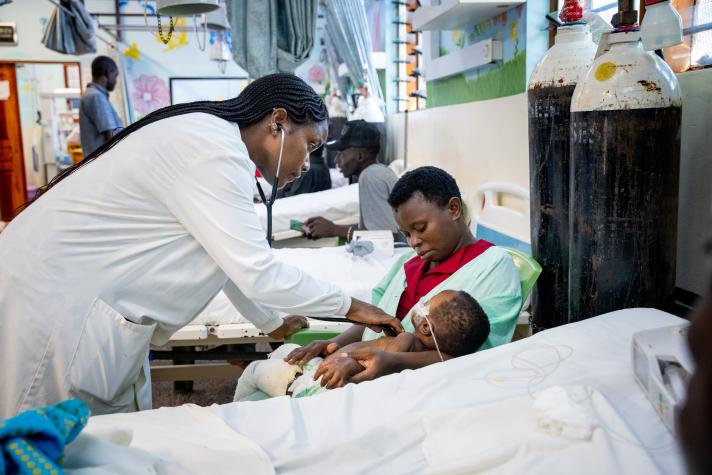
For decades, newborns who contracted malaria had no treatment developed specifically for them. Clinicians had to adapt formulations intended for older children, increasing the risk of dosing errors and toxicity. In 2025, Coartem® Baby became the first approved malaria treatment designed for these smallest patients.
The treatment was prequalified in April 2026 by the World Health Organisation (WHO) and added to its malaria guidelines in September 2026. A long-neglected gap had moved from clinical trial evidence into treatment guidance with the support of the European & Developing Countries Clinical Trials Partnership (EDCTP), a Europe-Africa partnership that has been advancing clinical research and improving access to health innovations in sub-Saharan Africa for over two decades.
Beyond malaria, EDCTP has funded research addressing gaps in the prevention, diagnosis and treatment of other infectious diseases such as HIV, Tuberculosis (TB), neglected tropical diseases and outbreaks such as Mpox and Ebola. Now in its third phase as Global Health EDCTP3, the partnership continues to support research contributing to new malaria vaccines, child-friendly treatments for worm infections, faster TB diagnosis, and the first oral treatment for sleeping sickness, among many others.
Malaria: expanding prevention and treatment options
The need for better malaria tools remains immense. In 2024, there were an estimated 282 million cases, resulting in 610,000 deaths, with the WHO African Region accounting for 94% of cases and 95% of deaths.
The approval of the first malaria vaccines, RTS,S and R21/Matrix-M, offered a new prevention and control tool for this disease. By early 2026, 25 African countries had introduced these vaccines into their routine immunisation programmes, with more than 39 million doses delivered.
Further evidence has also strengthened the case for existing antimalarial drugs, including Eurartesim® and Pyramax, helping guide their use across different patient groups and clinical settings.
HIV: developing medical solutions for overlooked patients
Children living with HIV were often administered formulations designed for adults. The CHAPAS programme helped advance child-friendly treatments. And for pregnant women living with HIV, the Kesho Bora trial found that a three-drug regimen reduced the risk of mother-to-child HIV transmission by 43% at 12 months.
The REMSTART study reduced deaths by 28% through early screening, preventive treatment and community support for people with advanced HIV. Building on efforts to improve outcomes for these patients, the AMBITION-cm trial helped establish a simpler treatment regimen for cryptococcal meningitis, based on a single high dose of liposomal amphotericin B.
Tuberculosis: faster diagnosis and safer treatment
For tuberculosis, which made an estimated 10.7 million people ill worldwide in 2024, the challenge is not just finding an effective treatment, but ensuring people are diagnosed quickly enough to receive it.
In Mozambique and Tanzania, the TB-CAPT CORE study tested portable diagnostic technology in primary care settings. Among patients diagnosed using the new approach, 97% started treatment within a week, compared with 63% under standard care.
The PredART trial also found that the preventive use of a drug reduced the proportion of people with TB and advanced HIV who developed a dangerous inflammatory complication from 47% to 30%.
Parasitic diseases: expanding treatment options
Research funded by EDCTP has also advanced options for neglected infectious diseases that have historically received less attention. These include a child-friendly treatment for parasitic worm infections, arpraziquantel for preschool children with schistosomiasis, simpler oral treatments for sleeping sickness and expanded use of moxidectin against river blindness, including in younger children.
Outbreaks: mobilising research when emergencies strike
EDCTP has mobilised funding rapidly to strengthen research and public health responses to infectious disease outbreaks. In September 2018, EDCTP launched its first emergency funding call, allocating €2.25 million in response to an Ebola outbreak in the Democratic Republic of the Congo (DRC).
In 2020, a second EDCTP emergency funding call was launched in response to the COVID-19 pandemic, realising €13.11 million to support 27 projects involving 25 countries from sub-Saharan Africa.
In 2024, Global Health EDCTP3 mobilised €12.1 million for nine research projects addressing mpox, bringing together 43 participating organisations across Africa, Europe and North America.
Most recently, in July 2026, it activated a further €4 million emergency funding mechanism in response to the Bundibugyo Ebola outbreak in the DRC and Uganda, which grew to a total call budget of €15.8 million thanks to co-funding leveraged from Wellcome and the Gates Foundation. The initiative builds on eight ongoing projects to strengthen surveillance, validate rapid diagnostic tests and advance potential treatments.
These responses are underpinned by long-term investment in African research capacity. Since 2007, EDCTP has supported regional networks that strengthen clinical research, collaboration and epidemic preparedness across sub-Saharan Africa.
A successful partnership model
These examples demonstrate the value of Africa-Europe collaboration through EDCTP in advancing research and developing solutions for major health challenges.
Since 2022, Global Health EDCTP3 has invested €722 million to fund 159 innovative projects addressing some of the world largest health challenges. This amount has been complemented by additional funds from the EDCTP Association member countries and some 100 contributing partners, highlighting the long-standing support from the European Union and the commitment of valuable strategic partners to global health research.
New co-funding opportunities will be made available in the Global Health EDCTP3 Work Programme 2027, which will be published in December 2026.
This article was published by Science|Business
Interested in more of what we do?
Read about the new and better medical solutions
Read about our lasting benefits
- Publication date
- 30 October 2026
- Author
- Global Health EDCTP3 Joint Undertaking